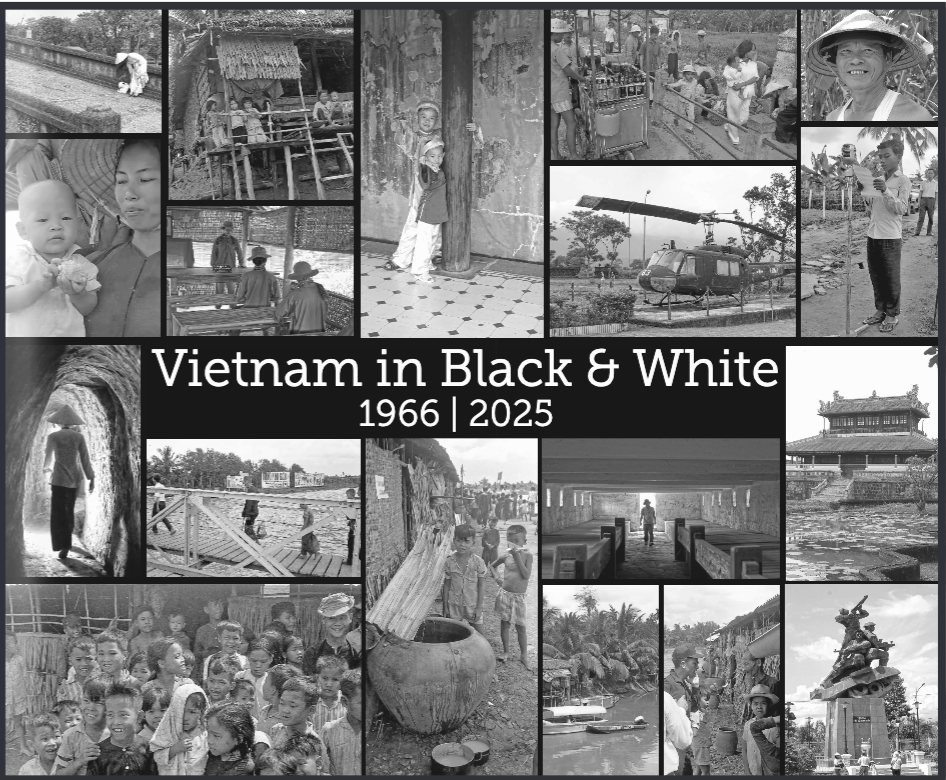
Vietnam in Black & White | 1966 |2025

Last year I took a trip to Vietnam and as part of my documentation I took photographs with my camera set on black and white with a 50mm lens. Years ago I came across a sheet of negatives of pictures my father took in 1966 on a one day visit to Vietnam's Delta. He served with the US government in Vietnam from 1965 to 1968. This is his only roll of B/W film that I have of his.
This book project presents his one day vision of Vietnam. My pictures show a variety of images from the southern part of Vietnam during my 10 day visit in 2025.
Note: the page images of the book are from screenshots from the editing program, so the quality is somewhat compromised and the text may be difficult to read, so I am including the photo caption text underneath each page |
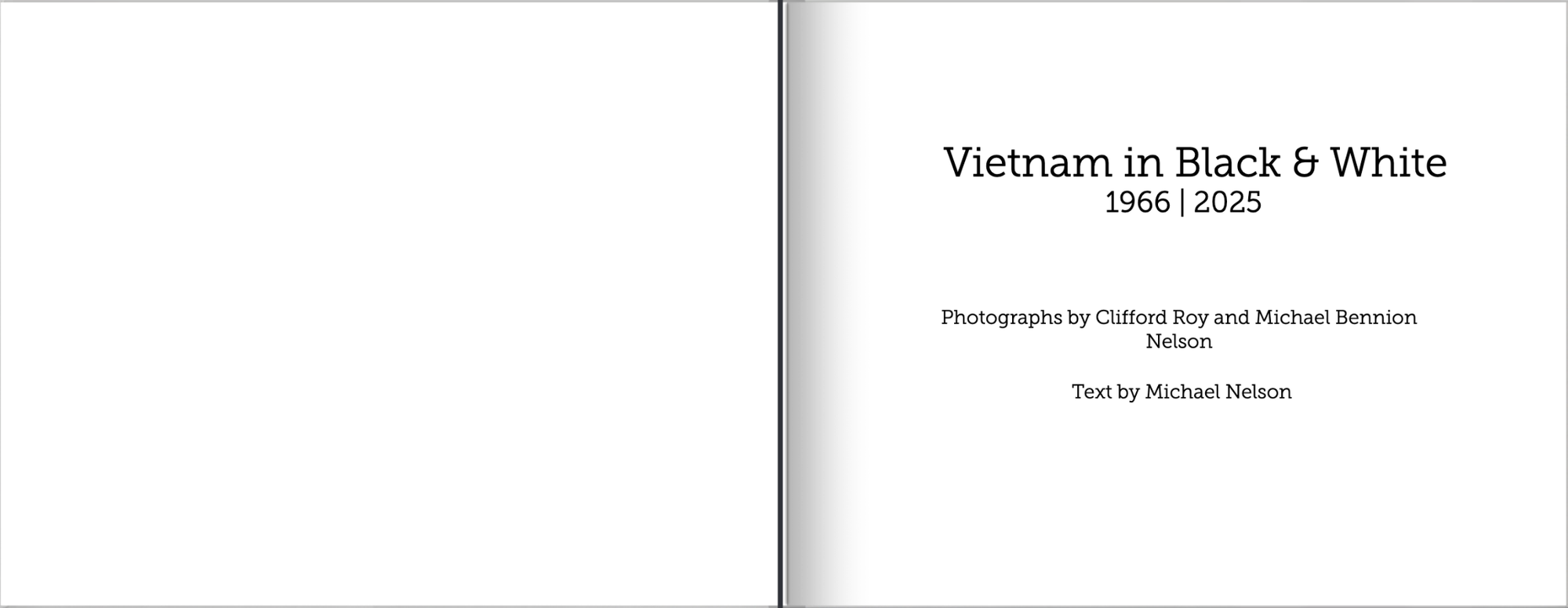
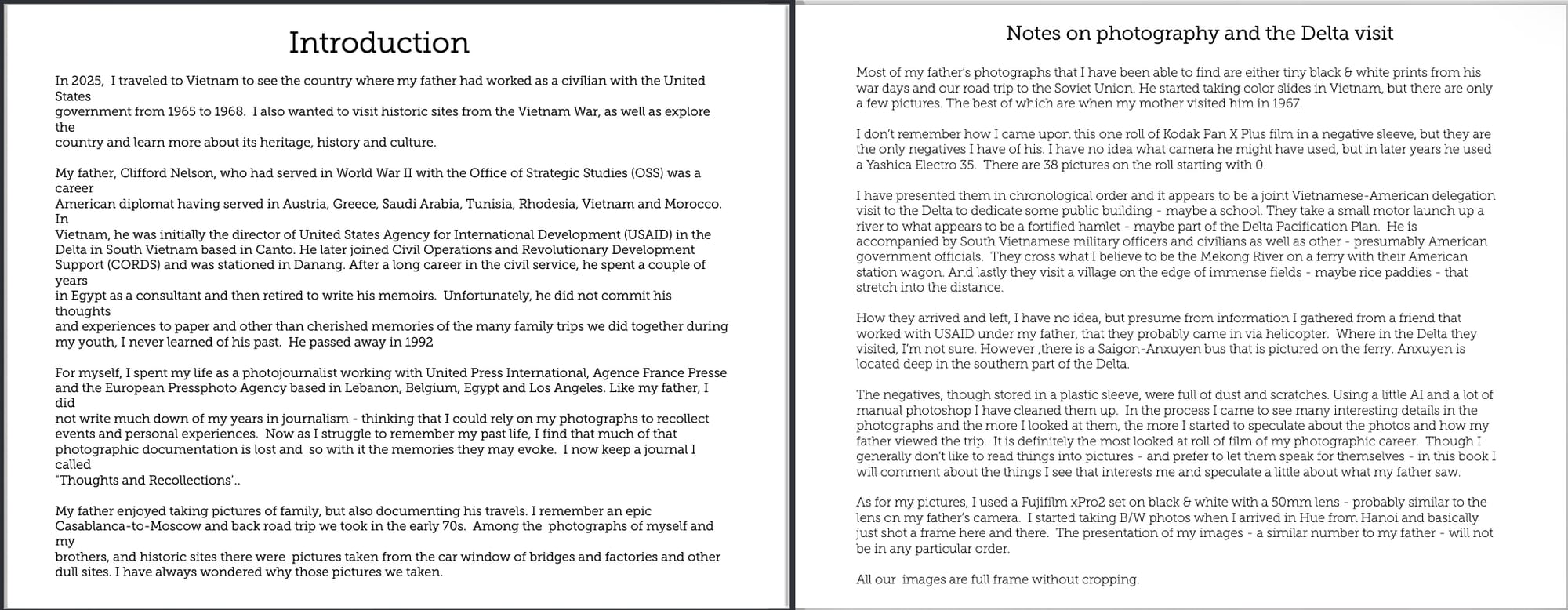
Left page |
Introduction
In 2025, I traveled to Vietnam to see the country where my father had worked as a civilian with the United States government from 1965 to 1968. I also wanted to visit historic sites from the Vietnam War, as well as explore the
country and learn more about its heritage, history and culture.
My father, Clifford Nelson, who had served in World War II with the Office of Strategic Studies (OSS) was a career American diplomat having served in Austria, Greece, Saudi Arabia, Tunisia, Rhodesia, Vietnam and Morocco.
In Vietnam, he was initially the director of United States Agency for International Development (USAID) in the Delta in South Vietnam based in Canto. He later joined Civil Operations and Revolutionary Development
Support (CORDS) and was stationed in Danang. After a long career in the civil service, he spent a couple of years in Egypt as a consultant and then retired to write his memoirs. Unfortunately, he did not commit his thoughts and experiences to paper and other than cherished memories of the many family trips we did together duringmy youth, I never learned of his past. He passed away in 1992.
For myself, I spent my life as a photojournalist working with United Press International, Agence France Presse and the European Pressphoto Agency based in Lebanon, Belgium, Egypt and Los Angeles. Like my father, I did not write much down of my years in journalism - thinking that I could rely on my photographs to recollect events and personal experiences. Now as I struggle to remember my past life, I find that much of that photographic documentation is lost and so with it the memories they may evoke. I now keep a journal I called "Thoughts and Recollections"..
My father enjoyed taking pictures of family, but also documenting his travels. I remember an epic Casablanca-to-Moscow and back road trip we took in the early 70s. Among the photographs of myself and my brothers, and historic sites there were pictures taken from the car window of bridges and factories and other dull sites. I have always wondered why those pictures we taken.
Right page |
Notes on Photography and the Delta visit
Most of my father’s photographs that I have been able to find are either tiny black & white prints from his war days and our road trip to the Soviet Union. He started taking color slides in Vietnam, but there are only a few pictures. The best of which are when my mother visited him in 1967.
I don’t remember how I came upon this one roll of Kodak Pan X Plus film in a negative sleeve, but they are the only negatives I have of his. I have no idea what camera he might have used, but in later years he used a Yashica Electro 35. There are 38 pictures on the roll starting with 0.
I have presented them in chronological order and it appears to be a joint Vietnamese-American delegation visit to the Delta to dedicate some public building - maybe a school. They take a small motor launch up a river to what appears to be a fortified hamlet - maybe part of the Delta Pacification Plan. He is
accompanied by South Vietnamese military officers and civilians as well as other - presumably American government officials. They cross what I believe to be the Mekong River on a ferry with their American station wagon. And lastly they visit a village on the edge of immense fields - maybe rice paddies - that stretch into the distance.
How they arrived and left, I have no idea, but presume from information I gathered from a friend that worked with USAID under my father, that they probably came in via helicopter. Where in the Delta they visited, I’m not sure. However ,there is a Saigon-Anxuyen bus that is pictured on the ferry. Anxuyen is
located deep in the southern part of the Delta.
The negatives, though stored in a plastic sleeve, were full of dust and scratches. Using a little AI and a lot of manual photoshop I have cleaned them up. In the process I came to see many interesting details in the photographs and the more I looked at them, the more I started to speculate about the photos and how my
father viewed the trip. It is definitely the most looked at roll of film of my photographic career. Though I generally don’t like to read things into pictures - and prefer to let them speak for themselves - in this book I will comment about the things I see that interests me and speculate a little about what my father saw.
As for my pictures, I used a Fujifilm xPro2 set on black & white with a 50mm lens - probably similar to the lens on my father’s camera. I started taking B/W photos when I arrived in Hue from Hanoi and basically just shot a frame here and there. The presentation of my images - a similar number to my father - will not
be in any particular order.
All our images are full frame without cropping.
Left page |
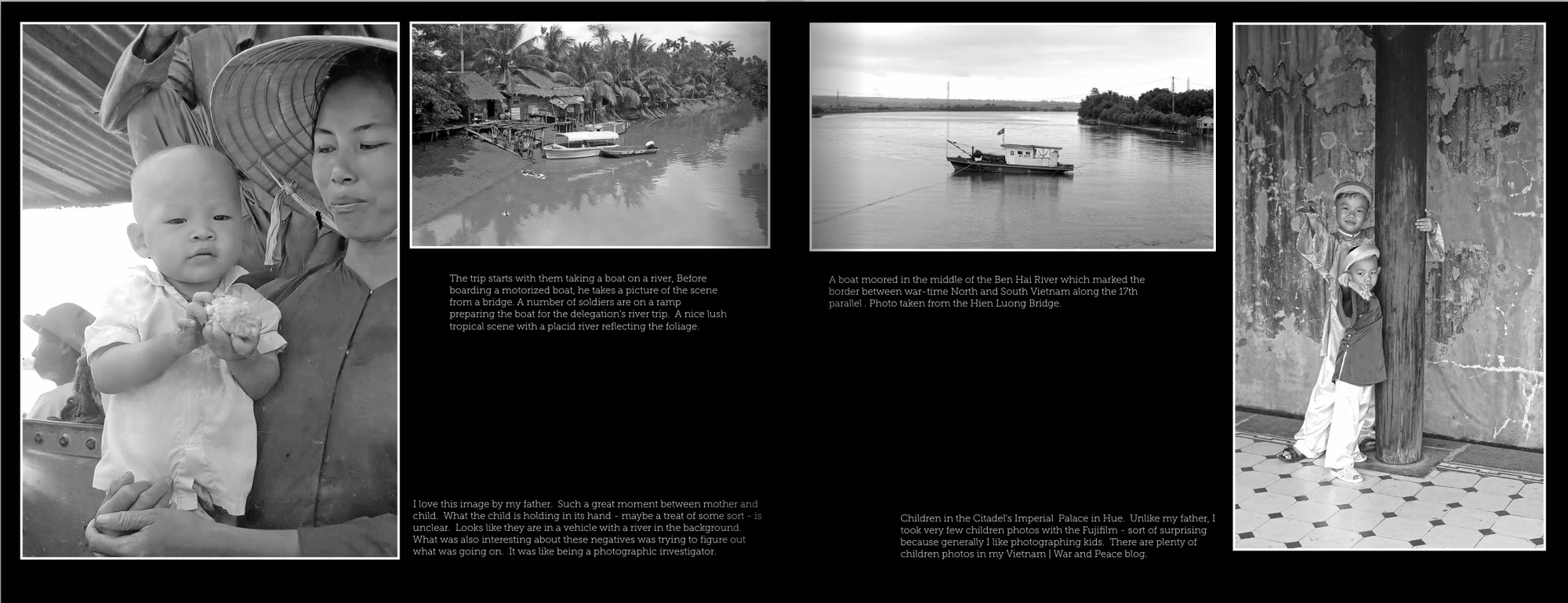
The trip starts with the delegation taking a boat on a river. Before boarding a motorized boat, he takes a picture of the scene from a bridge. A number of soldiers are on a ramp preparing the boat for the delegation’s river trip. A nice lush tropical scene with a placid river reflecting the foliage.
I love this image by my father. Such a great moment between mother and child. What the child is holding in its hand - maybe a treat of some sort - isunclear. Looks like they are in a vehicle with a river in the background. What was also interesting about these negatives was trying to figure out what was going on. It was like being a photographic investigator.
Right page |
Children in the Citadel palace in Hue. Unlike my father, I took very few children photos with the Fujifilm camera which is sort of surprising because generally I like photographing kids. There are plenty of children in my Vietnam | War and Peace Blog.
A boat moored in the middle of the Ben Hai River which marked the border between war-time North and South Vietnam along the 17th parallel . Photo taken from the Hien Luong Bridge.
Left Page |
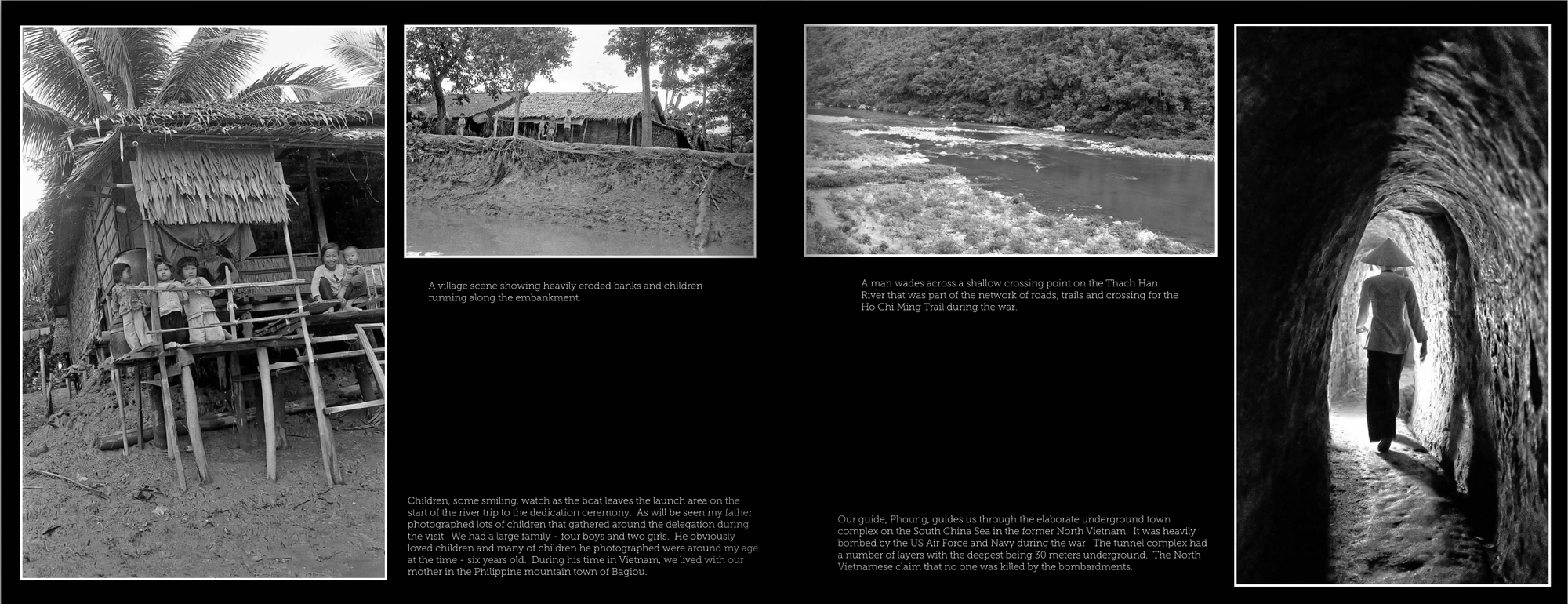
A village scene showing heavily eroded banks and children running along the embankment.
Children, some smiling, watch as the boat leaves the launch area on the start of the river trip to the dedication ceremony. As will be seen my father photographed lots of children that gathered around the delegation during the visit. We had a large family - four boys and two girls. He obviously loved children and many of children he photographed were around my age at the time - six years old. During his time in Vietnam, we lived with our mother in the Philippine mountain town of Bagiou.
Right page |
A man wades across a shallow crossing point on the Thach Han River that was part of the network of roads, trails and crossing for the Ho Chi Ming Trail during the war.
Our guide, Phoung, guides us through the elaborate underground town complex on the South China Sea in the former North Vietnam. It was heavily bombed by the US Air Force and Navy during the war. The tunnel complex had a number of layers with the deepest being 30 meters underground. The North Vietnamese claim that no one was killed by the bombardments.
Left page |
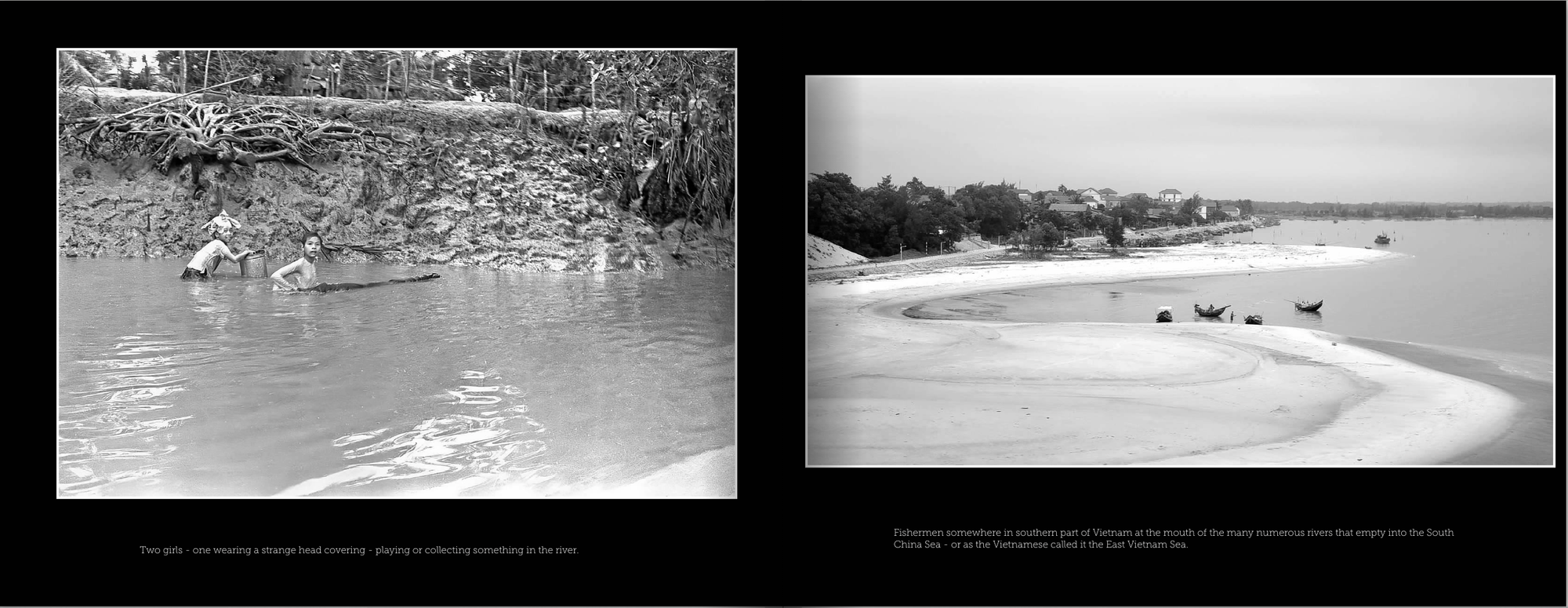
Two girls - one wearing a strange head covering - playing or collecting something in the river.
Right page |
Fishermen somewhere in southern part of Vietnam at the mouth of the many numerous rivers that empty into the South China Sea - or as the Vietnamese called it the East Vietnam Sea.
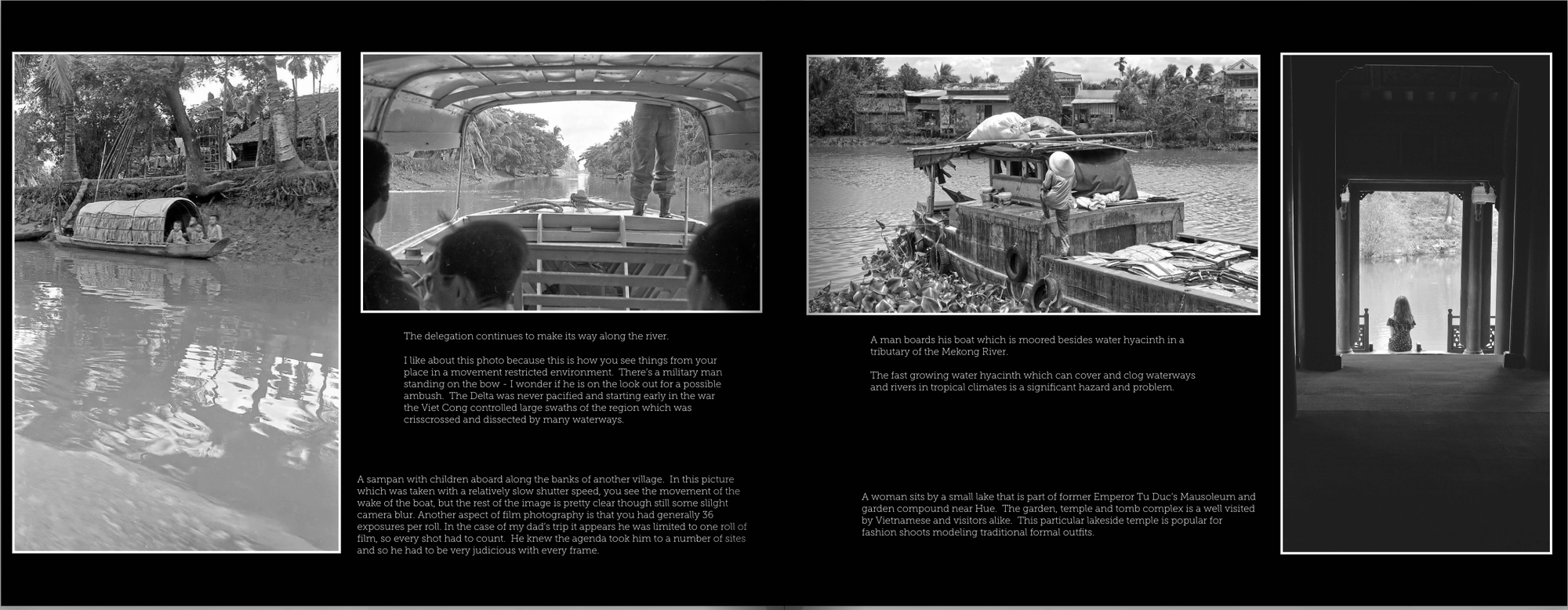
Left page |
The delegation continues to make its way along the river.
I like this photo because this is how you see things from your place in a movement restricted environment. There’s a military man standing on the bow - I wonder if he is on the look out for a possible ambush. The Delta was never pacified and starting early in the war the Viet Cong controlled large swaths of the region which was crisscrossed and dissected by many waterways.
A sampan with children along the banks of another village. In this picture
which was taken with a relatively slow shutter speed, you see the movement of the
wake of the boat, but the rest of the image is pretty clear though still some slight
camera blur. Another aspect of film photography is that you had generally 36
exposures per roll. In the case of my dad’s trip it appears he was limited to one roll of film, so every shot had to count. He knew the agenda took him to a number of sites and so he had to be very judicious with every frame.
Right page |
A man boards his boat which is moored besides water hyacinth in a tributary of the Mekong River.
The fast-growing water hyacinth which can cover and clog waterways and rivers in tropical climates is a significant hazard and problem.
A woman sits by a small lake that is part of former Emperor Tu Duc's Mausoleum and garden compound near Hue. The garden, temple and tomb complex is a well visited by Vietnamese and visitors alike. This particular lakeside temple is popular for fashion shoots modeling traditional formal outfits.
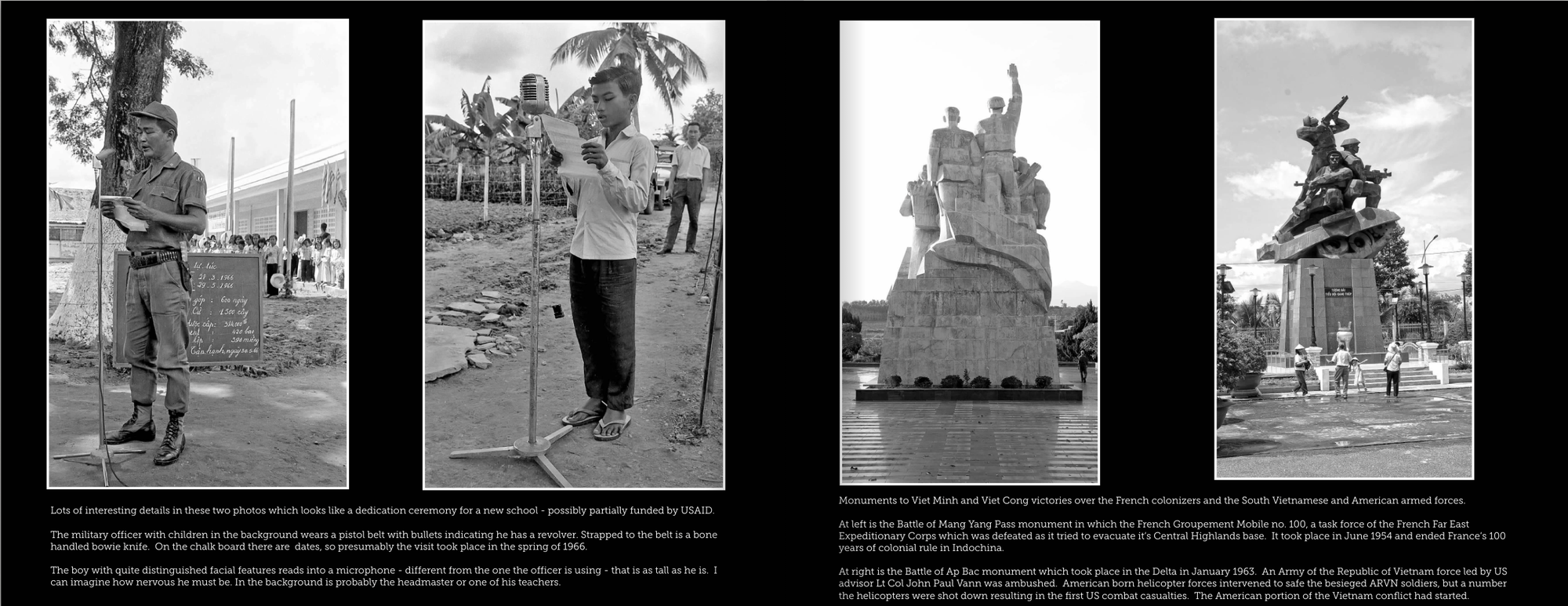
Left page |
Lots of interesting details in these two photos which looks like a dedication ceremony for a new school - possibly partially funded by USAID.
The military officer with children in the background wears a pistol belt with bullets indicating he has a revolver. Strapped to the belt is a bone handled bowie knife. On the chalk board there are dates, so presumably the visit took place in the spring of 1966.
The boy with quite distinguished facial features reads into a microphone - different from the one the officer is using - that is as tall as he is. I can imagine how nervous he must be. In the background is probably the headmaster or one of his teachers.
Right page |
Monuments to Viet Minh and Viet Cong victories over the French colonizers and the South Vietnamese and American armed forces.
At left is the Battle of Mang Yang Pass monument in which the French Groupement Mobile no. 100, a task force of the French Far East Expeditionary Corps which was defeated as it tried to evacuate it’s Central Highlands base. It took place in June 1954 and ended France’s 100 years of colonial rule in Indochina.
At right is the Battle of Ap Bac monument which took place in the Delta in January 1963. An Army of the Republic of Vietnam force led by US advisor Lt Col John Paul Vann was ambushed. American born helicopter forces intervened to safe the besieged ARVN soldiers, but a number the helicopters were shot down resulting in the first US combat casualties. The American portion of the Vietnam conflict had started.
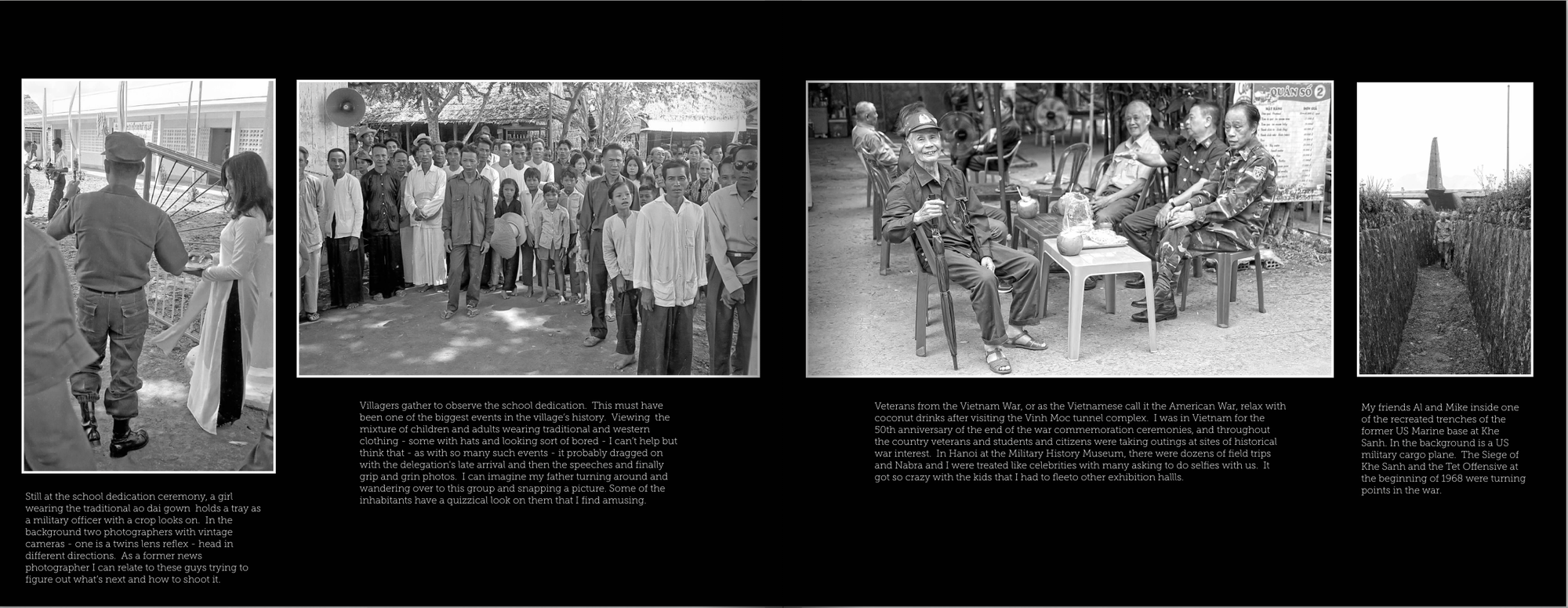
Page left |
Still at the school dedication ceremony, a girl wearing the traditional ao dai gown holds a tray as a military officer with a crop looks on. In the background two photographers with vintage cameras - one is a twins lens reflex - head in different directions. As a former news photographer I can relate to these guys trying to
figure out what’s next and how to shoot it.
Villagers gather to observe the school dedication. This must have been one of the biggest events in the village’s history. Viewing the mixture of children and adults wearing traditional and western clothing - some with hats and looking sort of bored - I can’t help but think that - as with so many such events - it probably dragged on with the delegation's late arrival and then the speeches and finally grip and grin photos. I can imagine my father turning around and wandering over to this group and snapping a picture. Some of the inhabitants have a quizzical look on them that I find amusing.
Right page |
Veterans from the Vietnam War, or as the Vietnamese call it the American War, relax with coconut drinks after visiting the Vinh Moc tunnel complex. I was in Vietnam for the 50th anniversary of the end of the war commemoration ceremonies, and throughout the country veterans and students and citizens were taking outings at sites of historical war interest. In Hanoi at the Military History Museum, there were dozens of field trips and Nabra and I were treated like celebrities with many asking to do selfies with us. It got so crazy with the kids that I had to flee to other exhibition halls.
My friends Al and Mike inside one of the recreated trenches of the former US Marine base at Khe Sanh. In the background is a US military cargo plane. The Siege of Khe Sanh and the Tet Offensive at the beginning of 1968 were turning
points in the war.
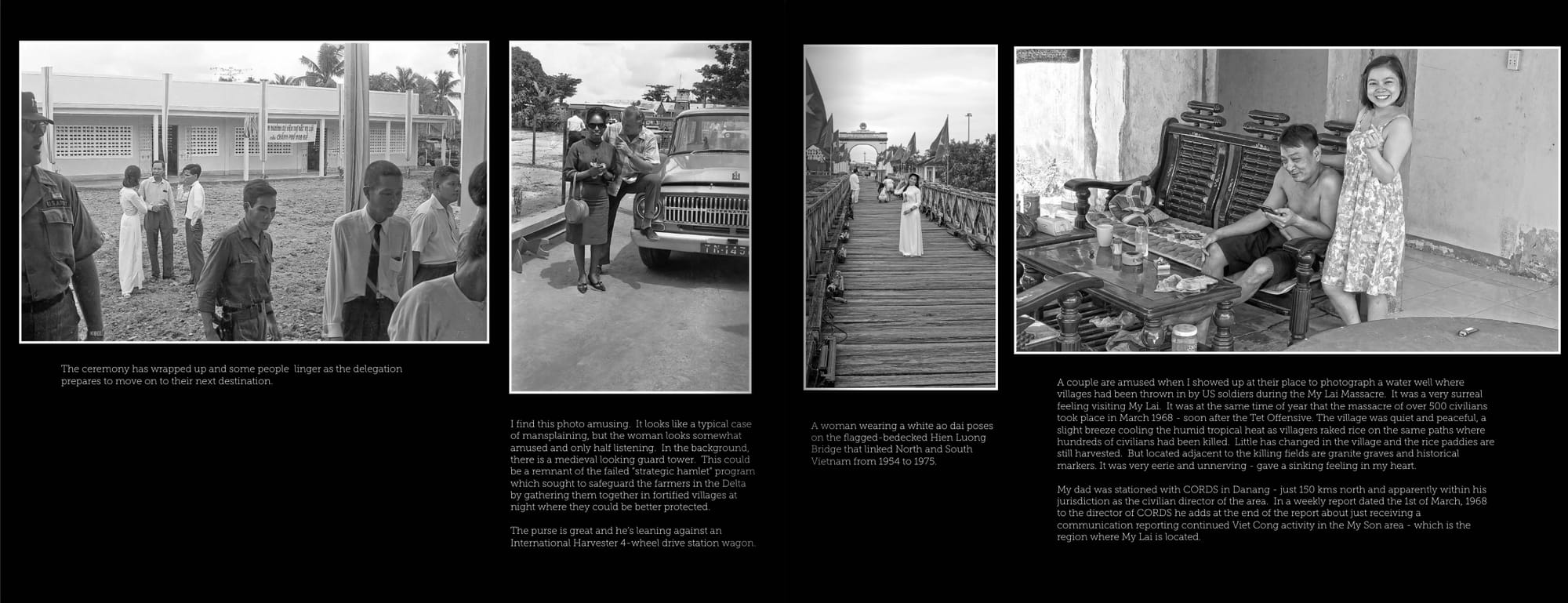
Left page |
The ceremony has wrapped up and some people linger as the delegation prepares to move on to their next destination.
I find this photo amusing. It looks like a typical case of mansplaining, but the woman looks somewhat amused and only half listening. In the background,
there is a medieval looking guard tower. This could be a remnant of the failed “strategic hamlet” program which sought to safeguard the farmers in the Delta by gathering them together in fortified villages at night where they could be better protected.
The purse is great and he’s leaning against an International Harvester 4-wheel drive station wagon.
Right page |
A woman wearing a white ao dai poses on the flagged-bedecked Hien Luong Bridge that linked North and South Vietnam from 1954 to 1975. A couple are amused when I showed up at their place to photograph a water well where villages had been thrown in by US soldiers during the My Lai Massacre. It was a very surreal
feeling visiting My Lai. It was at the same time of year that the massacre of over 500 civilians took place in March 1968 - soon after the Tet Offensive. The village was quiet and peaceful, a slight breeze cooling the humid tropical heat as villagers raked rice on the same paths where hundreds of civilians had been killed. Little has changed in the village and the rice paddies are still harvested. But located adjacent to the killing fields are granite graves and historical markers. It was very eerie and unnerving - gave a sinking feeling in my heart.
My dad was stationed with CORDS in Danang - just 150 kms north and apparently within his jurisdiction as the civilian director of the area. In a weekly report dated the 1st of March, 1968 to the director of CORDS he adds at the end of the report about just receiving a communication reporting continued Viet Cong activity in the My Son area - which is the region where My Lai is located.
Left page |
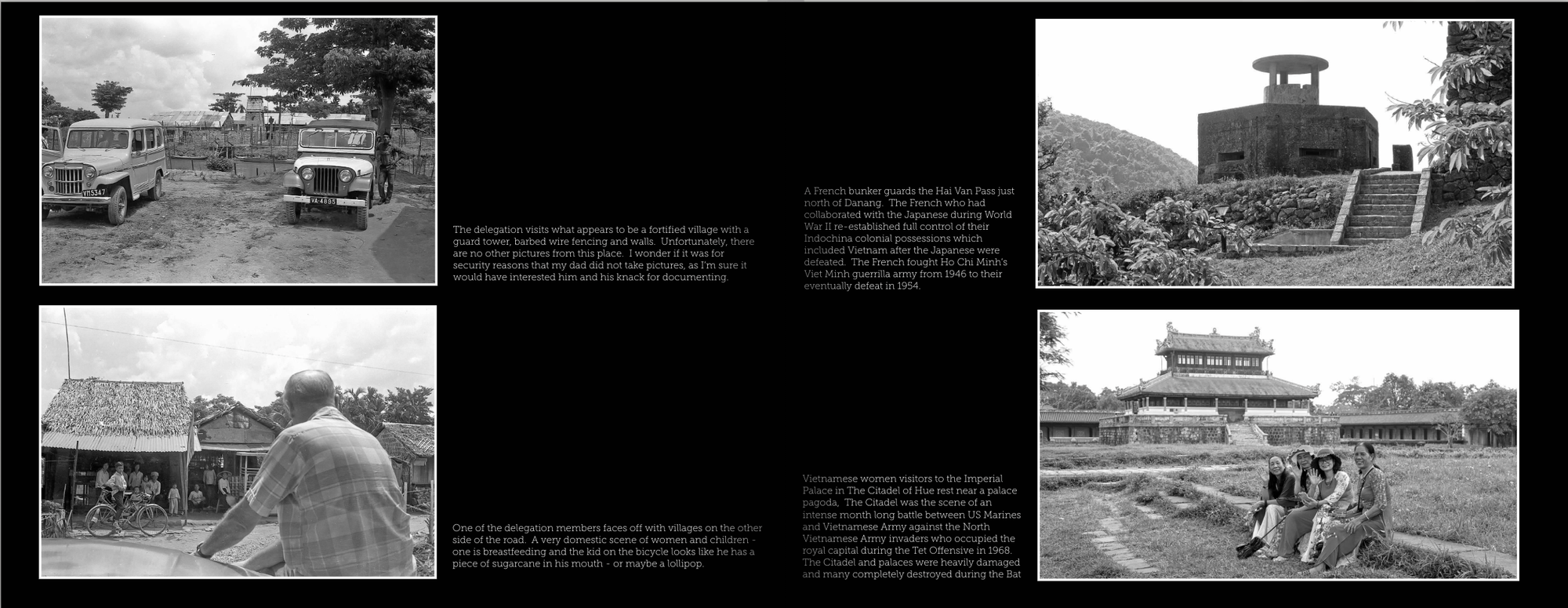
The delegation visits what appears to be a fortified village with a guard tower, barbed wire fencing and walls. Unfortunately, there are no other pictures from this place. I wonder if it was for security reasons that my dad did not take pictures, as I’m sure it would have interested him and his knack for documenting.
One of the delegation members faces off with villages on the other side of the road. A very domestic scene of women and children - one is breastfeeding and the kid on the bicycle looks like he has a piece of sugarcane in his mouth - or maybe a lollipop.
Right page |
A French bunker guards the Hai Van Pass just north of Danang. The French who had collaborated with the Japanese during World War II re-established full control of their Indochina colonial possessions which included Vietnam after the Japanese were defeated. The French fought Ho Chi Minh’s Viet Minh guerrilla army from 1946 to their eventually defeat in 1954.
Vietnamese women visitors to the Imperial Palace in The Citadel of Hue rest near a palace pagoda, The Citadel was the scene of an intense month long battle between US Marines and Vietnamese Army against the North Vietnamese Army invaders who occupied the royal capital during the Tet Offensive in 1968. The Citadel and palaces were heavily damaged and many completely destroyed during the Battle for Hue.
Left page |
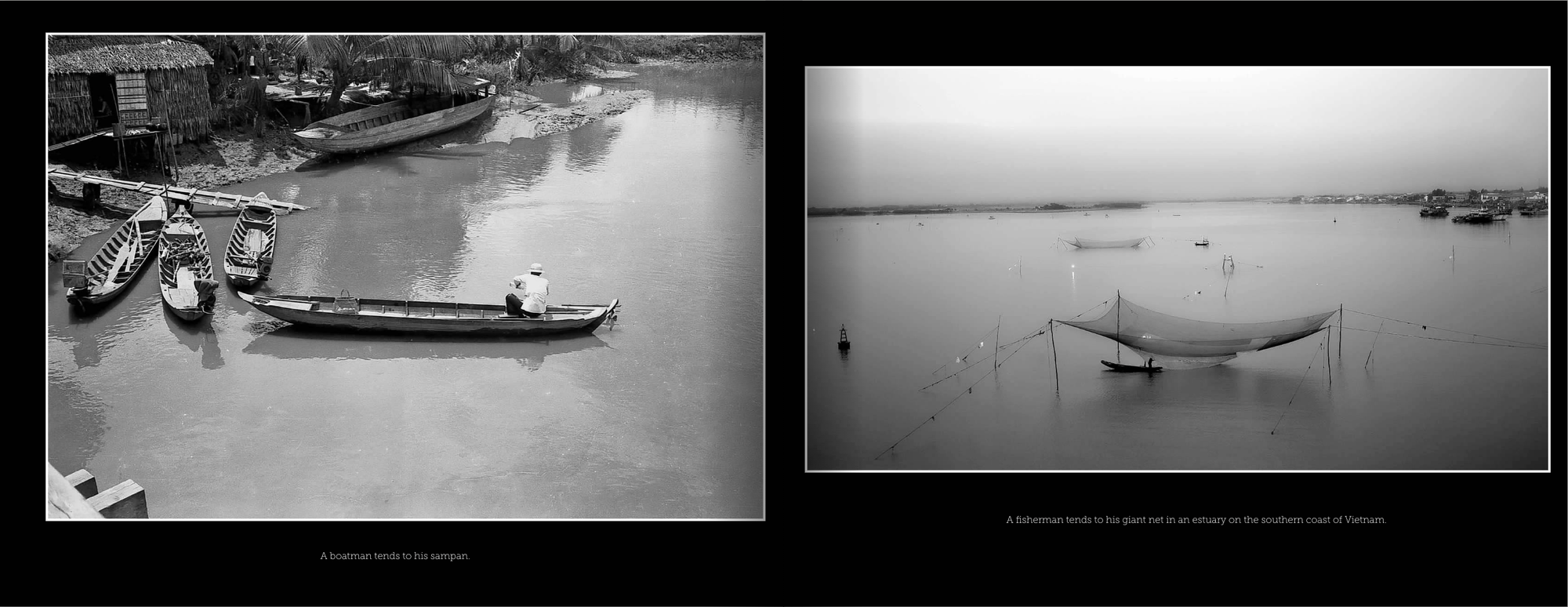
A boatman tends to his sampan.
Right page |
A fisherman tends to his giant net in an estuary on the southern coast of Vietnam.
Left page |
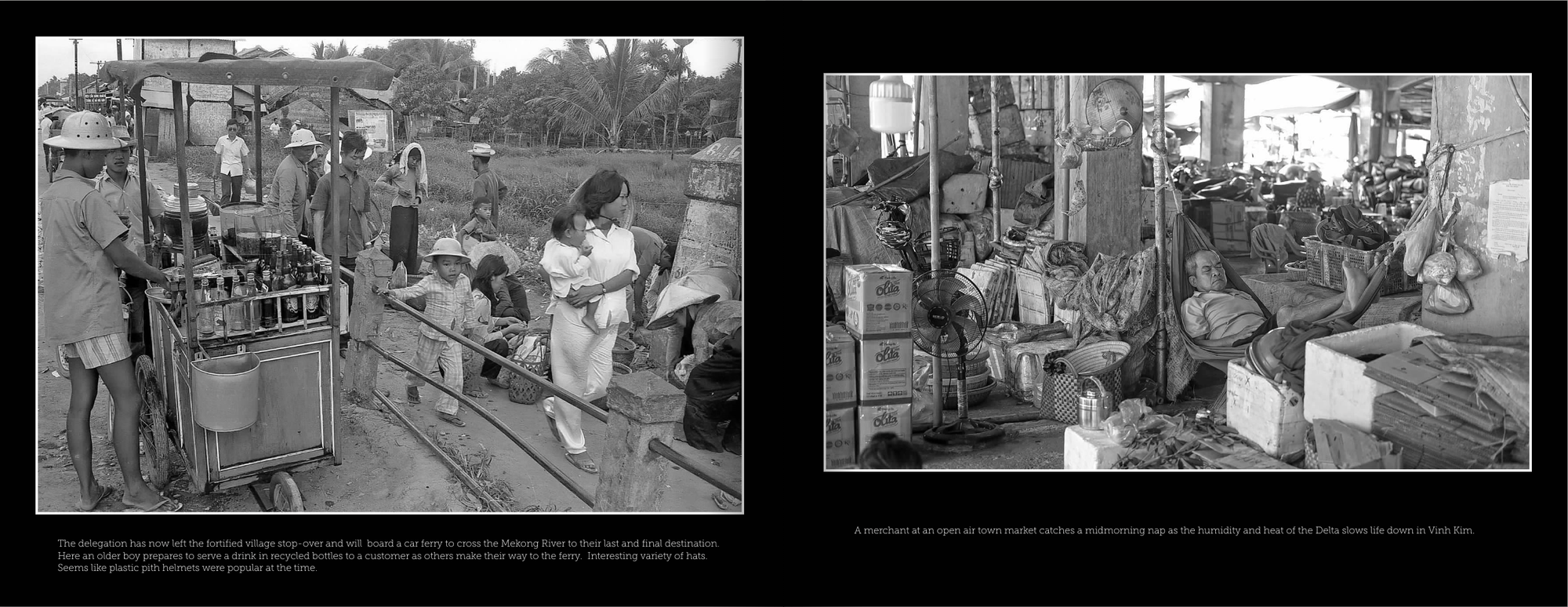
The delegation has now left the fortified village stop-over and will board a car ferry to cross the Mekong River to their last and final destination. Here an older boy prepares to serve a drink in recycled bottles to a customer as others make their way to the ferry. Interesting variety of hats. Seems like plastic pith helmets were popular at the time.
Right page |
A merchant at an open air town market catches a midmorning nap as the humidity and heat of the Delta slows life down in Vinh Kim.
Left page |
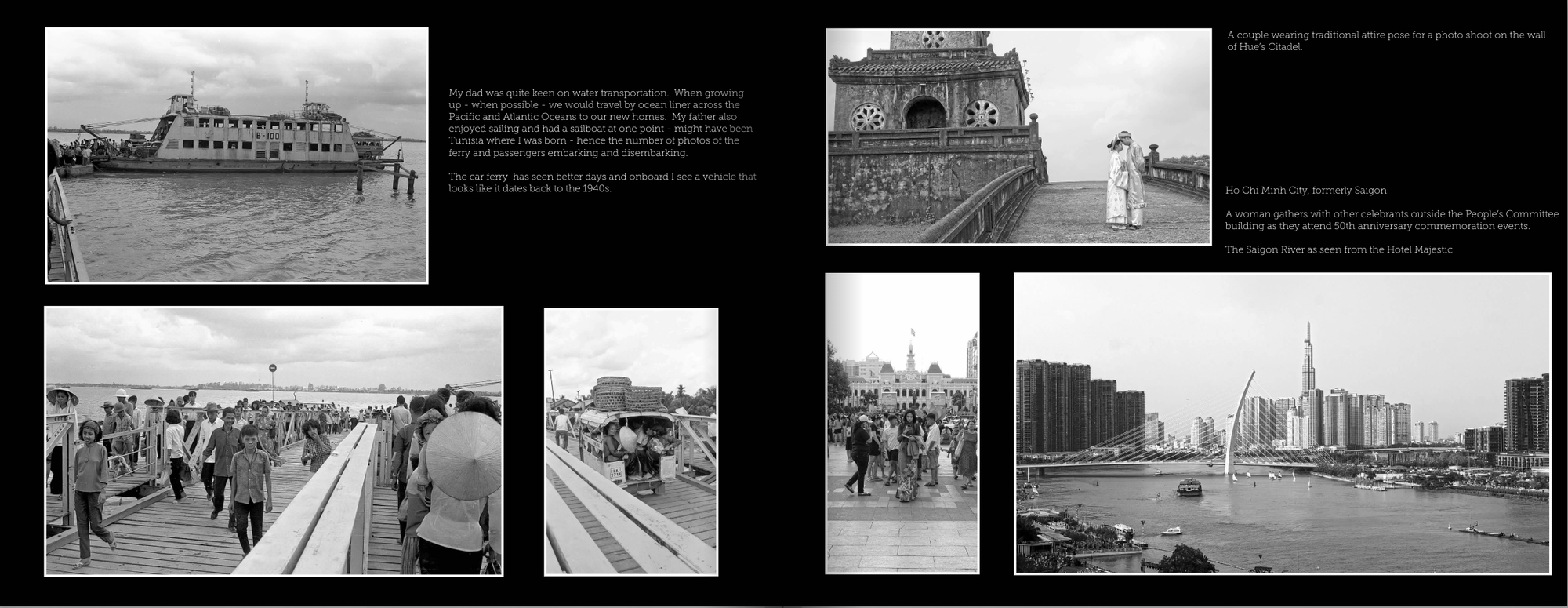
My dad was quite keen on water transportation. When growing up - when possible - we would travel by ocean liner across the Pacific and Atlantic Oceans to our new homes. My father also enjoyed sailing and had a sailboat at one point - might have been Tunisia where I was born - hence the number of photos of the ferry and passengers embarking and disembarking.
The car ferry has seen better days and onboard I see a vehicle that looks like it dates back to the 1940s.
Right page |
A couple wearing traditional attire pose for a photo shoot on the wall of Hue’s Citadel.
Ho Chi Minh City, formerly Saigon.
A woman gathers with other celebrants outside the People’s Committee
building as they attend 50th anniversary commemoration events.
The Saigon River as seen from the Hotel Majestic
Left page |
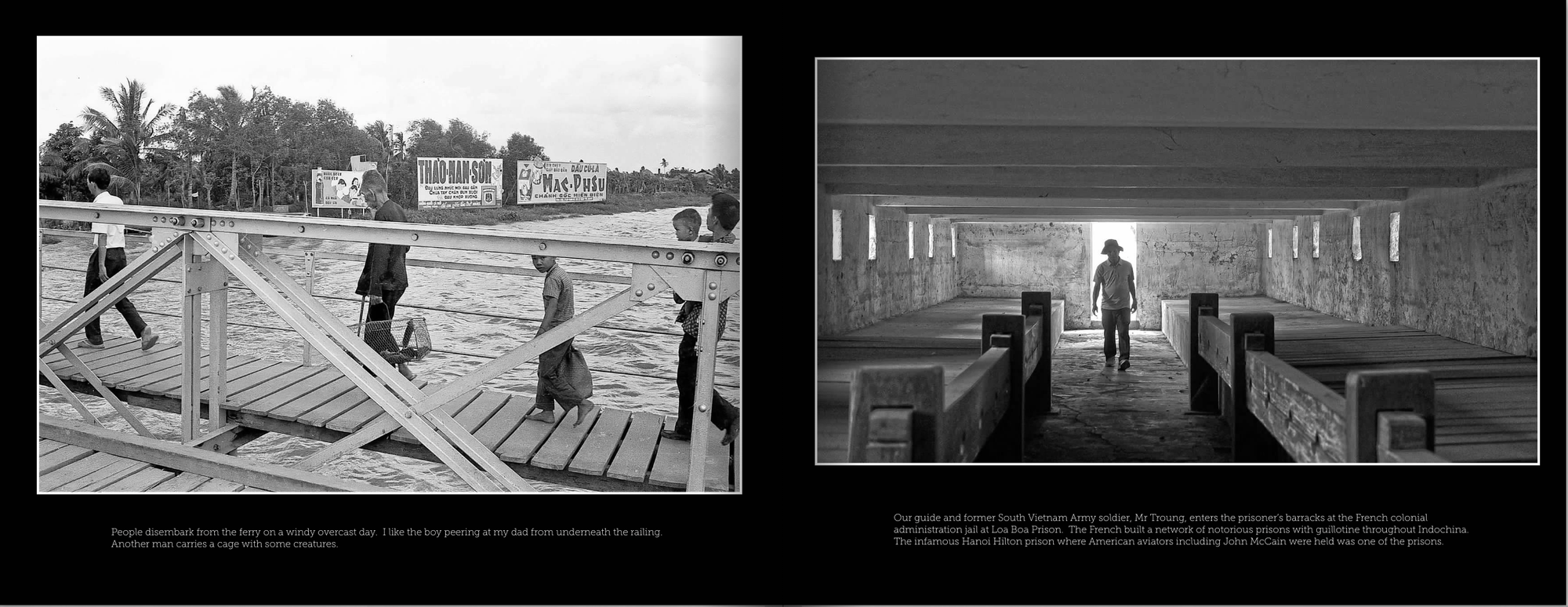
People disembark from the ferry on a windy overcast day. I like the boy peering at my dad from underneath the railing. Another man carries a cage with some creatures.
Right page |
Our guide and former South Vietnam Army soldier, Mr Troung, enters the prisoner’s barracks at the French colonial administration jail at Loa Boa Prison. The French built a network of notorious prisons with guillotine throughout Indochina. The infamous Hanoi Hilton prison where American aviators including John McCain were held was one of the prisons.
Left page |
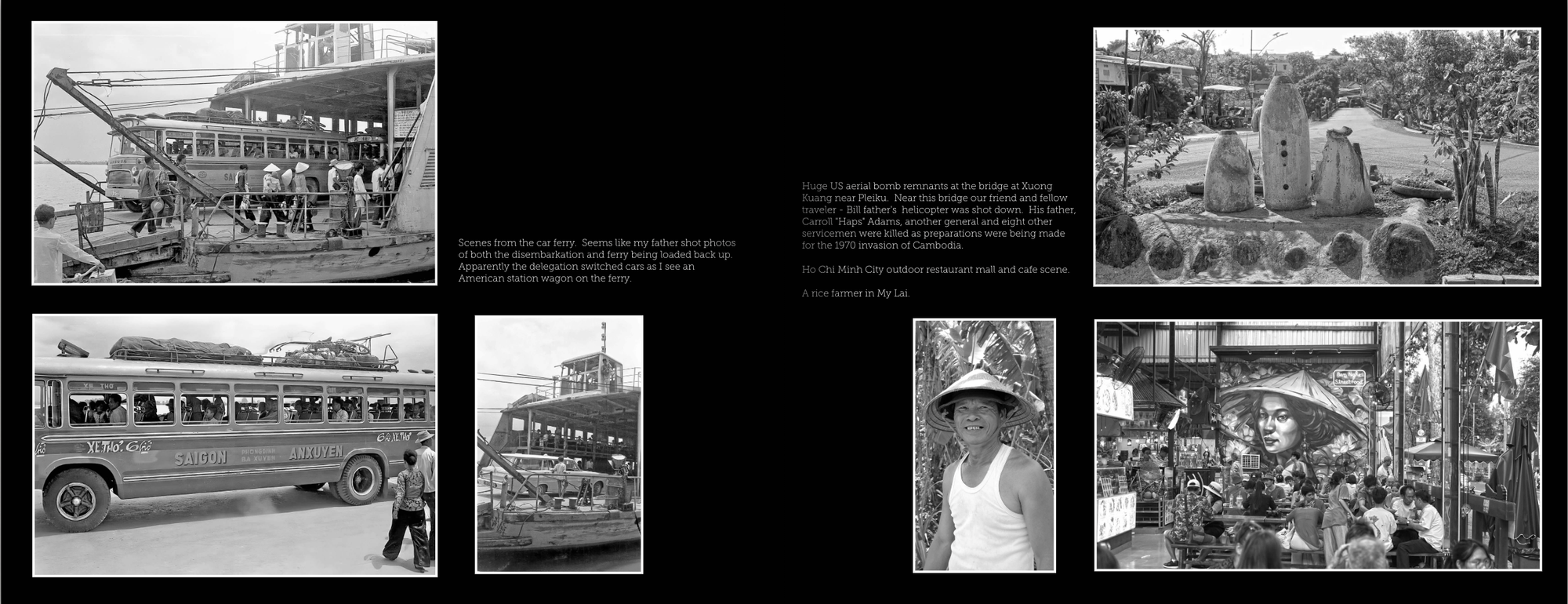
Scenes from the car ferry. Seems like my father shot photos of both the disembarkation and ferry being loaded back up. Apparently the delegation switched cars as I see an American station wagon on the ferry.
Right page |
Huge US aerial bomb remnants at the bridge at Xuong Kuang near Pleiku. Near this bridge our friend and fellow traveler - Bill father's helicopter was shot down. His father, Carroll "Haps" Adams, another general and eight other servicemen were killed as preparations were being made for the 1970 invasion of Cambodia.
Ho Chi Minh City outdoor restaurant mall and cafe scene.
A rice farmer in My Lai.
Left page |
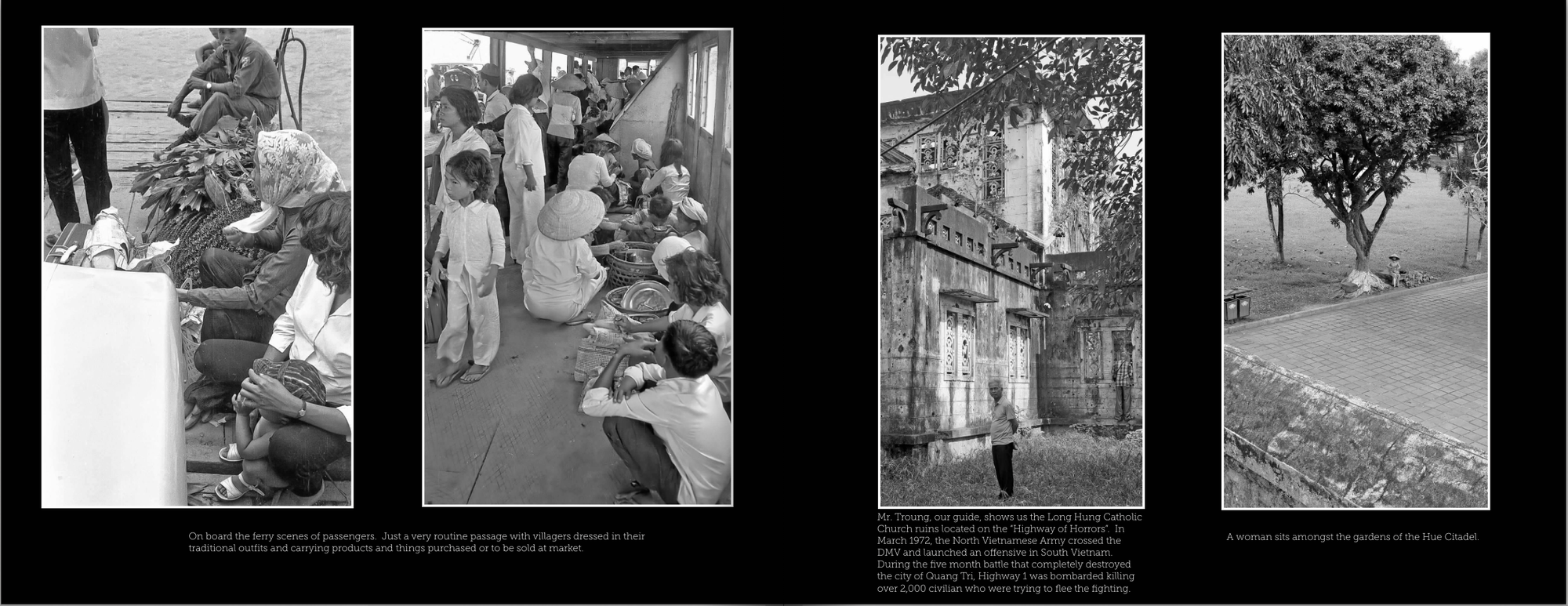
On board the ferry scenes of passengers. Just a very routine passage with villagers dressed in their traditional outfits and carrying products and things purchased or to be sold at market.
Right page |
Mr. Troung, our guide, shows us the Long Hung Catholic Church ruins located on the “Highway of Horrors”. In March 1972, the North Vietnamese Army crossed the
DMV and launched an offensive in South Vietnam. During the five month battle that completely destroyed the city of Quang Tri, Highway 1 was bombarded killing
over 2,000 civilian who were trying to flee the fighting.
A woman sits amongst the gardens of the Hue Citadel.
Left page |
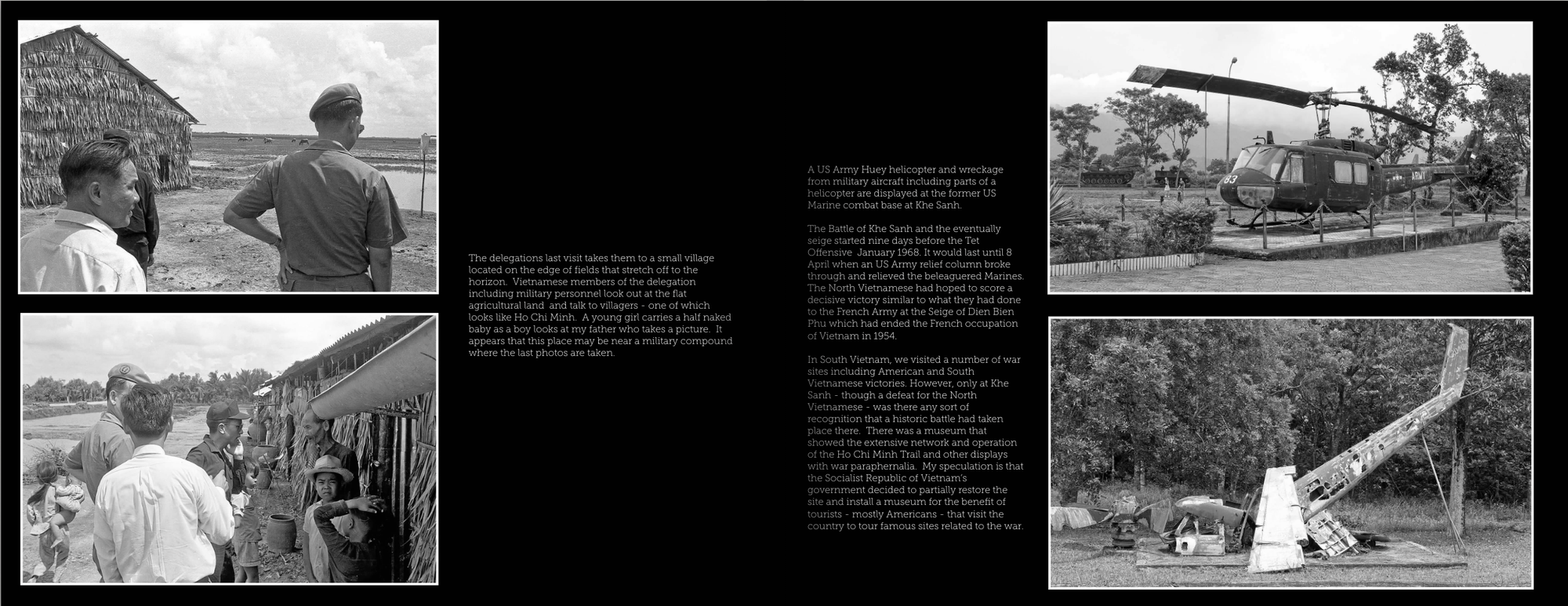
The delegations last visit takes them to a small village located on the edge of fields that stretch off to the horizon. Vietnamese members of the delegation including military personnel look out at the flat agricultural land and talk to villagers - one of which looks like Ho Chi Minh. A young girl carries a half naked baby as a boy looks at my father who takes a picture. It appears that this place may be near a military compound where the last photos are taken.
Right page |
A US Army Huey helicopter and wreckage from military aircraft including parts of a helicopter are displayed at the former US Marine combat base at Khe Sanh.
The Battle of Khe Sanh and the seige started nine days before the Tet Offensive January 1968. It would last until 8 April when an US Army relief column broke
through and relieved the beleaguered Marines. The North Vietnamese had hoped to score a decisive victory similar to what they had done to the French Army at the Seige of Dien Bien Phu which had ended the French occupation of Vietnam in 1954.
In South Vietnam, we visited a number of war sites including American and South
Vietnamese victories. However, only at Khe Sanh - though a defeat for the North
Vietnamese - was there any sort of recognition that a historic battle had taken place there. There was a museum that showed the extensive network and operation of the Ho Chi Minh Trail and other displays with war paraphernalia. My speculation is that the Socialist Republic of Vietnam’s government decided to partially restore the site and install a museum for the benefit of tourists - mostly Americans - that visit the country to tour famous sites related to the war.
Left page |
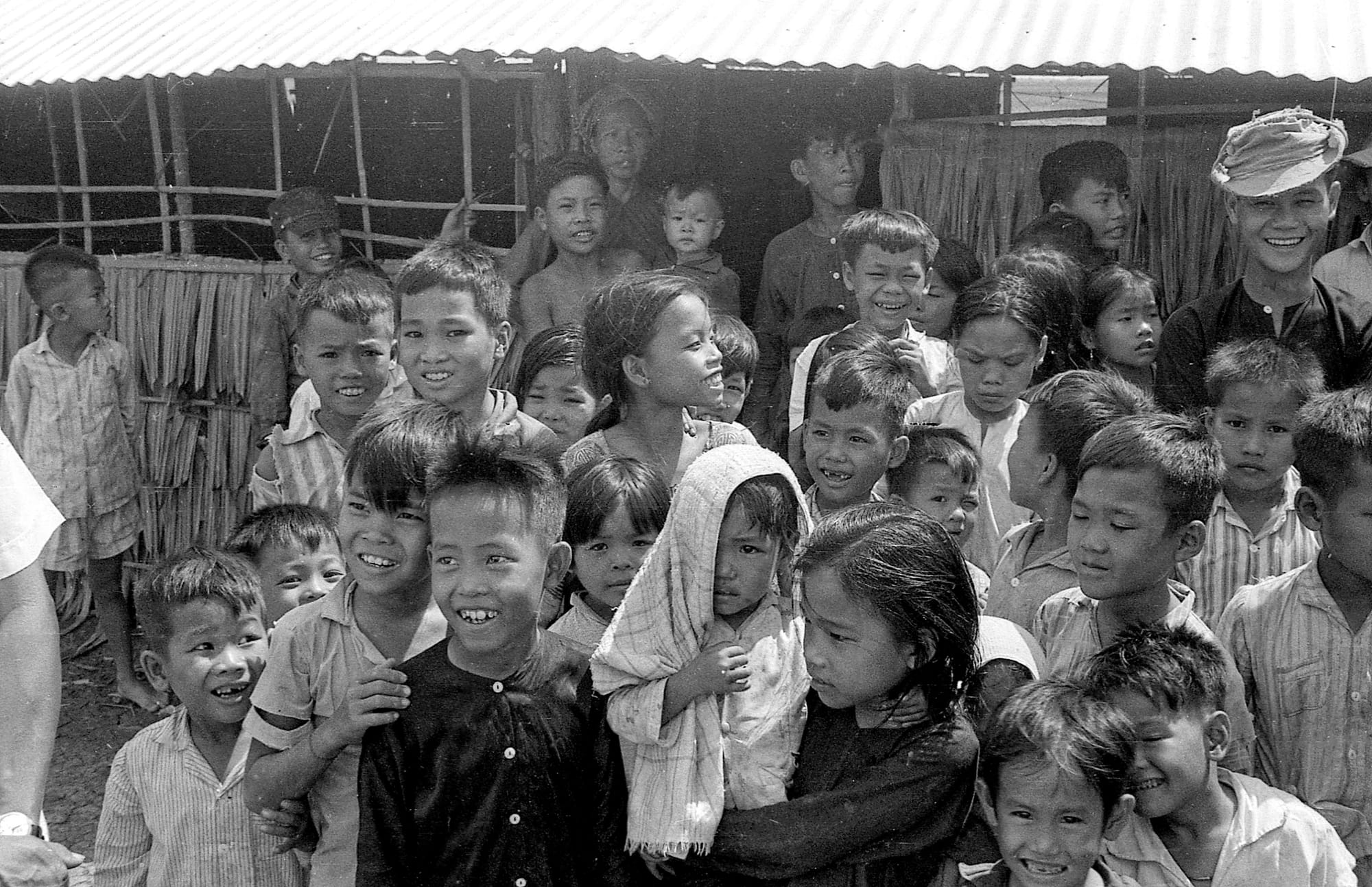
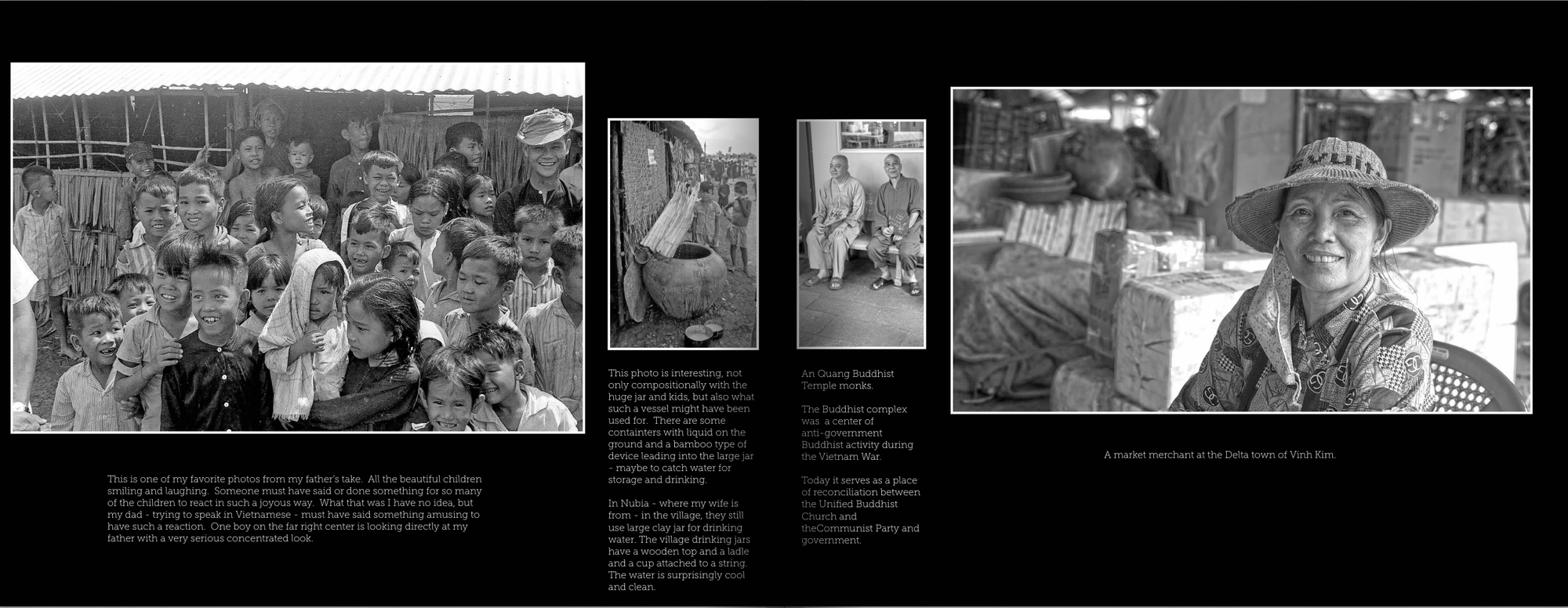
This is one of my favorite photos from my father’s take. All the beautiful children
smiling and laughing. Someone must have said or done something for so many of the children to react in such a joyous way. What that was I have no idea, but my dad - trying to speak in Vietnamese - must have said something amusing to have such a reaction. One boy on the far right center is looking directly at my father with a very serious concentrated look.
This photo is interesting, not only compositionally with the huge jar and kids, but also what such a vessel might have been used for. There are some containers with liquid on the ground and a bamboo type of device leading into the large jar maybe to catch water for storage and drinking.
In Nubia - where my wife is from - in the village, they still use large clay jar for drinking water. The village drinking jars have a wooden top and a ladle and a cup attached to a string. The water is surprisingly cool. and clean.
Right page |
An Quang Buddhist Temple monks.
The Buddhist complex was a center of anti-government Buddhist activity during the Vietnam War.
Today it serves as a place of reconciliation between the Unified Buddhist Church and the Communist Party and government.
A market merchant at the Delta town of Vinh Kim.
Left page |
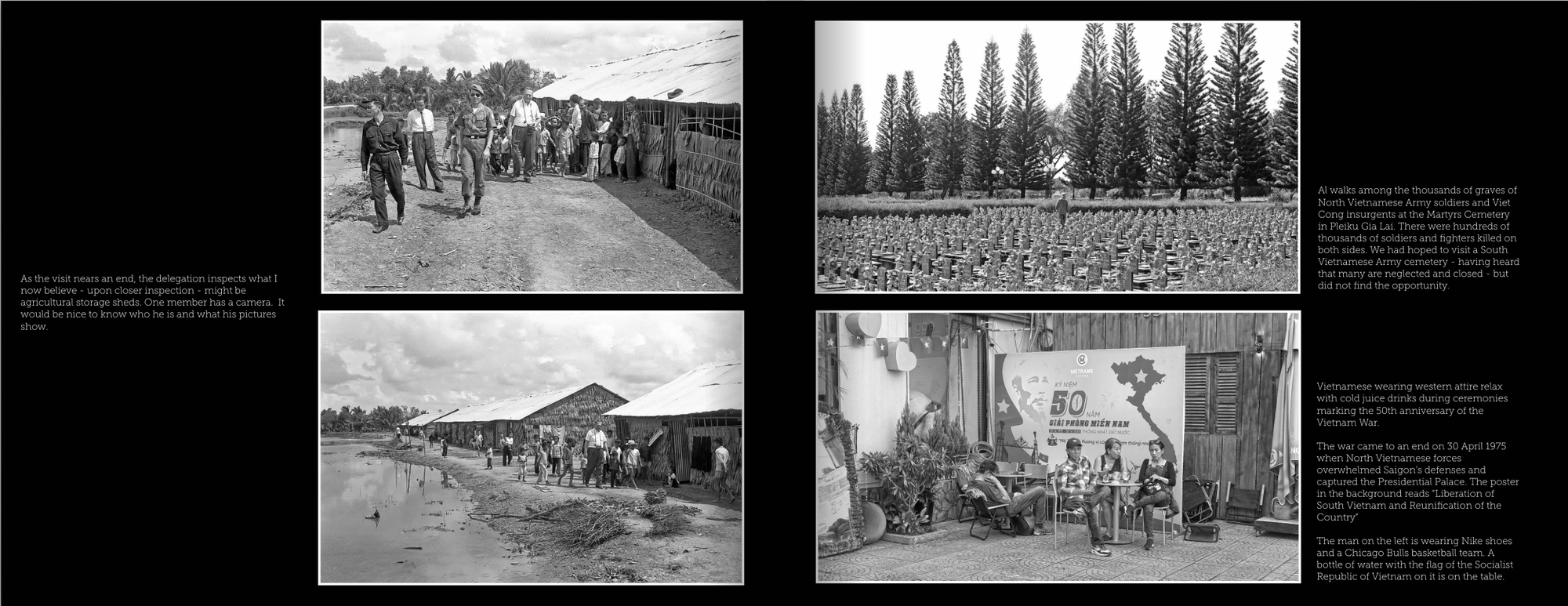
As the visit nears an end, the delegation inspects what I now believe - upon closer inspection - might be agricultural storage sheds. One member has a camera. It would be nice to know who he is and what his pictures show.
Right page |
Al walks among the thousands of graves of North Vietnamese Army soldiers and Viet Cong insurgents at the Martyrs Cemetery in Pleiku Gia Lai. There were hundreds of thousands of soldiers and fighters killed on both sides. We had hoped to visit a South Vietnamese Army cemetery - having heard that many are neglected and closed - but did not find the opportunity.
Vietnamese wearing western attire relax with cold juice drinks during ceremonies
marking the 50th anniversary of the Vietnam War.
The war came to an end on 30 April 1975 when North Vietnamese forces
overwhelmed Saigon’s defenses and captured the Presidential Palace. The poster
in the background reads “Liberation of South Vietnam and Reunification of the
Country”
The man on the left is wearing Nike shoes and a Chicago Bulls basketball team cap. A bottle of water with the flag of the Socialist Republic of Vietnam on it is on the table.
Left page |
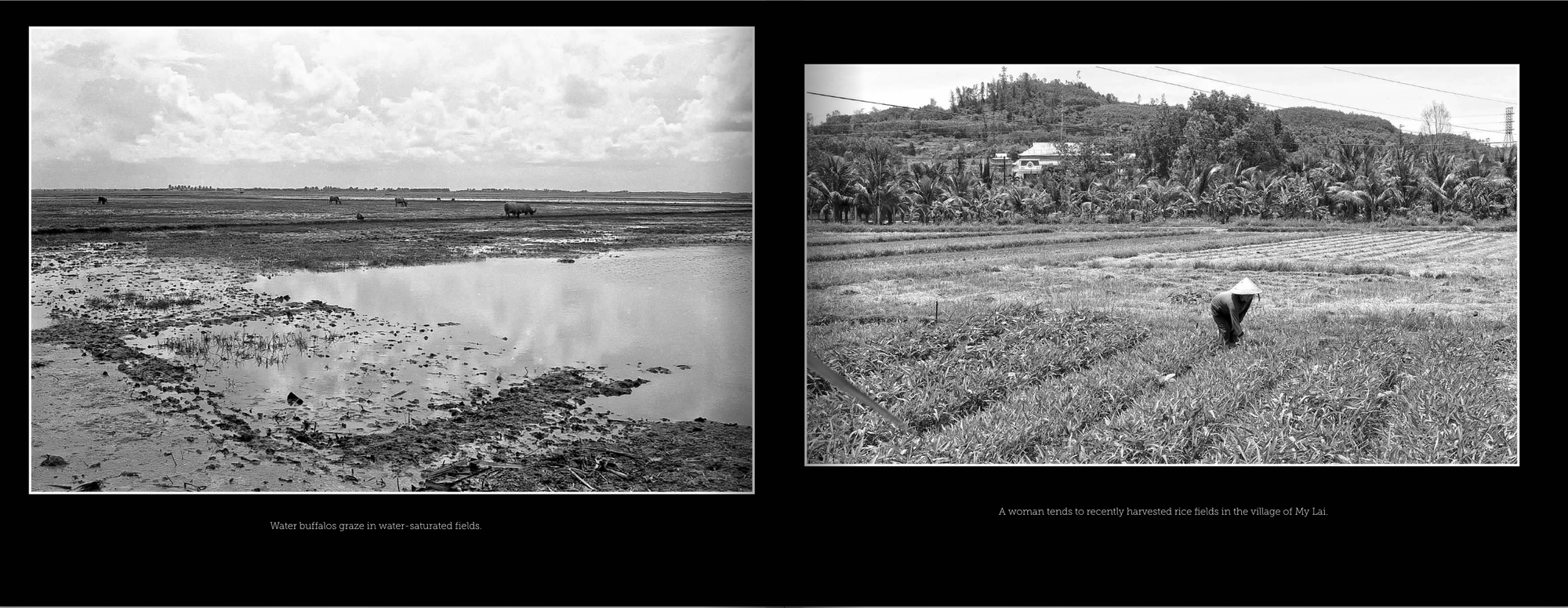
Water buffalos graze in water-saturated fields.
Right page |
A woman tends to recently harvested rice fields in the village of My Lai.
Left page |
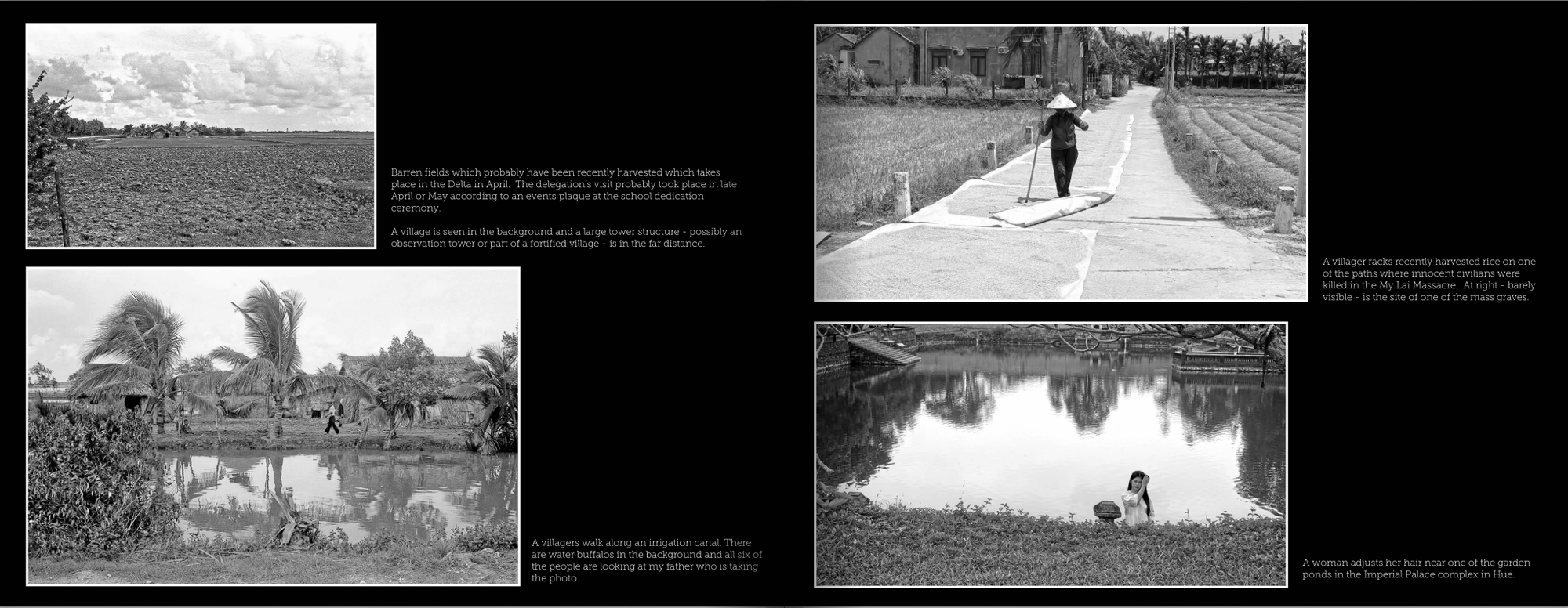
Barren fields which probably have been recently harvested which takes place in the Delta in April. The delegation’s visit probably took place in late April or May according to an events plaque at the school dedication ceremony.
A village is seen in the background and a large tower structure - possibly an
observation tower or part of a fortified village - is in the far distance.
A villagers walk along an irrigation canal. There are water buffalos in the background and all six of the people are looking at my father who is taking
the photo.
Right page |
A villager rakes recently harvested rice on one of the paths where civilians were killed in the My Lai Massacre. At right - barely visible - is the site of one of the mass graves.
A woman adjusts her hair near one of the garden ponds in the Imperial Palace complex in Hue.
Left page |
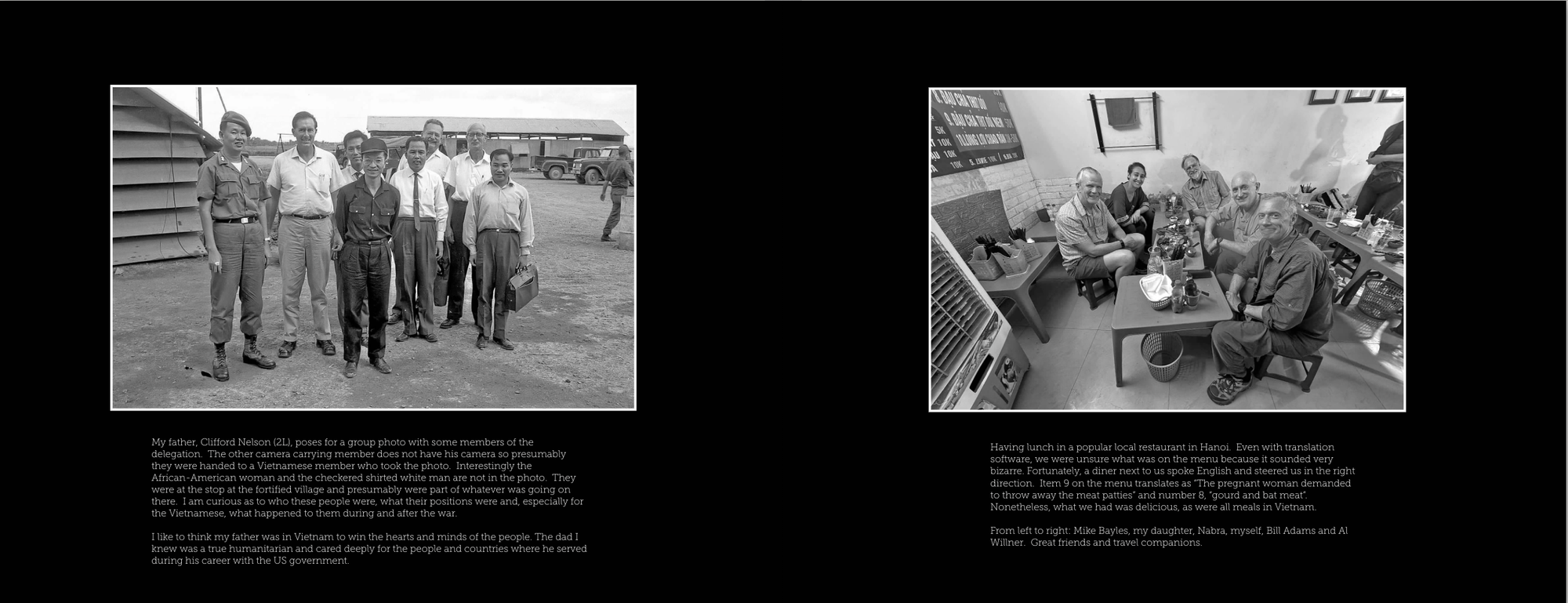
My father, Clifford Nelson (2L), poses for a group photo with some members of the
delegation. The other camera carrying member does not have his camera so presumably they were handed to a Vietnamese member who took the photo. Interestingly the African-American woman and the checkered shirted white man are not in the photo. They were at the stop at the fortified village and presumably were part of whatever was going on there. I am curious as to who these people were, what their positions were and, especially for the Vietnamese, what happened to them during and after the war.
I like to think my father was in Vietnam to win the hearts and minds of the people. The dad I knew was a true humanitarian and cared deeply for the people and countries where he served during his career with the US government.
Right page |
Having lunch in a popular local restaurant in Hanoi. Even with translation
software, we were unsure what was on the menu because it sounded very bizarre. Fortunately, a diner next to us spoke English and steered us in the right direction. Item 9 on the menu translates as “The pregnant woman demanded to throw away the meat patties” and number 8, “gourd and bat meat”. Nonetheless, what we had was delicious, as were all meals in Vietnam.
From left to right: Mike Bayles, my daughter, Nabra, myself, Bill Adams and Al
Willner. Great friends and travel companions.
Left page |
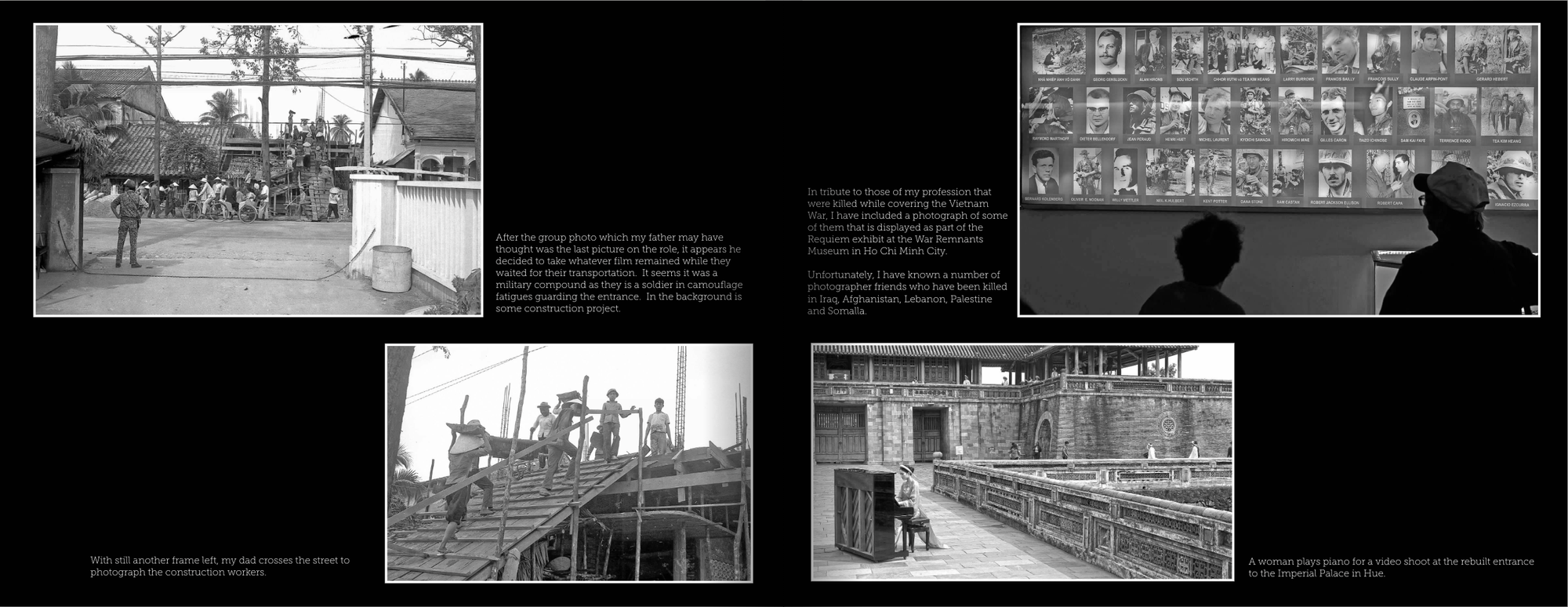
After the group photo which my father may have thought was the last picture on the role, it appears he decided to take whatever film remained while they waited for their transportation. It seems it was a military compound as they is a soldier in camouflage fatigues guarding the entrance. In the background is some construction project.
With still another frame left, my dad crosses the street to photograph the construction workers.
Right page |
In tribute to those of my profession that were killed while covering the Vietnam War, I have included a photograph of some of them that is displayed as part of the
Requiem exhibit at the War Remnants Museum in Ho Chi Minh City.
Unfortunately, I have known a number of photographer friends who have been killed in Iraq, Afghanistan, Lebanon, Palestine and Somalia.
A woman plays piano for a video shoot at the rebuilt entrance to the Imperial Palace in Hue.